


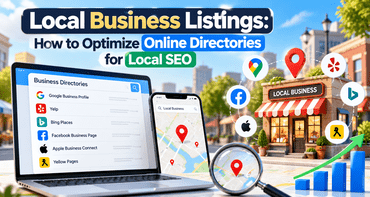
Finding a local business online isn’t as simple as having a website. Your customers may discover you through Google, maps, review platforms, or online directories before they ever visit your site. That’s why accurate local business listings have become an important part of modern local SEO. When your business name, services, phone number, hours, and website details stay consistent across trusted platforms, customers can find and trust you more easily. Well-managed listings can also strengthen your local search visibility, support your Google Maps presence, and create valuable referral opportunities. In this guide, you’ll learn how to optimize your listings, fix common citation issues, choose the right directories, and build a stronger online presence that turns local searches into real customers.
Getting found locally can feel like a crowded race. Your competitors may offer similar services, yet one business keeps appearing when customers search nearby. Often, the difference starts with accurate local business listings, strong online visibility, and a well-managed digital presence.
Your website matters, but it isn’t the whole picture. Customers also discover companies through maps, directories, review platforms, and industry websites. When these sources show consistent information, they make it easier for people and search engines to understand who you are and what you offer.
What Are Local Business Listings and Online Directories?
A local business listing is a digital profile containing essential business information such as your name, address, phone number, website, hours, category, and services. Customers may find that profile through local directories, search engines, maps, or review platforms while looking for a nearby provider.
An online business directory works like a modern business index. Instead of flipping through an old phone book, people search digitally by business type, service, location, or category. These directory profiles can introduce your company to customers who haven’t discovered your website yet.
What Is a Local Business Listing?
Think of a listing as your business’s digital introduction. It tells customers what you do, where you operate, and how they can contact you. A complete profile may include your business name, phone number, website URL, hours, photos, services, and customer reviews.
The details matter because incomplete profiles create friction. A customer shouldn’t have to hunt for your hours or wonder whether your phone number still works. Accurate information creates a smoother journey from search to visit, call, appointment, or purchase.
What Are Online Business Directories?
Online directories collect information about businesses and organize it into searchable profiles. Some directories cover almost every industry, while others focus on specific professions. These online directory sites can provide discovery opportunities beyond traditional Google searches.
For example, a homeowner might find a contractor through Google, Yelp, an industry directory, or a local chamber website. Each source can become another doorway into the business. That’s why a strong online presence extends beyond your own website.
Local Business Listings vs. Local Citations
The terms sound similar, but they aren’t identical. A local citation generally refers to a mention of your business’s core details across the web. A structured citation often includes your name, address, and phone number, while a directory profile can contain far more information.
For local SEO, both matter as part of your broader digital footprint. Strong business citations can reinforce consistent facts about your company. Meanwhile, complete directory listings can provide customers with services, reviews, photos, links, and other useful details.
General vs. Niche Business Directories
General directories serve businesses across many industries. Niche directories concentrate on a particular profession, such as legal services, healthcare, construction, or real estate. For a U.S. company, relevant industry-specific directories can be especially useful because they place your business in a more focused context.
Consider a roofing company. A profile on a broad directory can provide general exposure, but a respected roofing or contractor directory may reach people already seeking that service. Relevance often beats sheer volume when building your local SEO strategy.
Why Are Local Business Listings Important for SEO?
Local search has a simple goal: connect people with useful nearby businesses. Google says local results are primarily influenced by relevance, distance, and prominence. Complete and accurate business information helps Google understand whether a business matches a customer’s search.
That makes listing accuracy more than an administrative task. Your local search visibility depends on a wider collection of signals and information. Consistent business profiles can support discovery across search, maps, directories, and other platforms while helping customers find reliable information.
How Business Listings Support Local Search Visibility
When someone searches for a service near them, search engines need enough information to understand the businesses that could satisfy the query. Your categories, services, location details, website content, and other signals help establish relevance.
For example, a person searching for “emergency plumber near me” has a clear local need. A well-developed profile can communicate that the business offers plumbing services and serves the appropriate area. That supports better search visibility without relying on awkward keyword repetition.
How Listings Support Google Maps and the Local Pack
Google Business Profile allows businesses to manage how they appear across Google Search and Maps. Google also states that verified profiles can help customers find businesses and interact through information, photos, and reviews.
The familiar Google Maps Pack, sometimes called the Google 3-Pack, can attract significant attention during local searches. However, a directory listing alone won’t guarantee placement. Think of listings as supporting pieces within a broader local pack rankings strategy.
Why NAP Consistency Matters
NAP means name, address, and phone number. These details should remain accurate wherever your business appears. If one directory displays an old number while another shows a different business name, customers may hesitate before contacting you.
Maintain consistent NAP consistency across important profiles while respecting each platform’s formatting requirements. Your business address and phone number should reflect reality. Don’t change legitimate business details simply to make every platform look visually identical.
Why Directory Quality Matters More Than Listing Quantity
More listings don’t automatically mean better results. A hundred weak profiles can create more maintenance work without delivering meaningful value. Instead, focus on reputable platforms, relevant local business directory, trusted industry resources, and directories that your customers actually use.
A smaller collection of accurate profiles can be easier to manage and more valuable than a sprawling citation footprint. Prioritize citation accuracy, relevance, ownership, and customer usefulness before chasing another directory submission.
What Are the Benefits of Local Business Directory Listings?
A well-managed directory presence can create value far beyond rankings. Customers use different discovery paths, so appearing in multiple trustworthy places increases the number of opportunities for someone to encounter your company. Those encounters can lead to website visits, calls, requests, or bookings.
There is also a credibility benefit. When customers find matching business information across reputable platforms, your company looks established and easier to verify. Reviews, photos, service descriptions, and online reviews can then help customers decide whether they want to contact you.
Increase Local Online Visibility
Visibility begins with being present where customers search. Google remains important, but customers also use maps, review websites, social platforms, and industry resources. A strong online footprint gives your business more opportunities to appear during different stages of the buying journey.
For a local contractor, one person might search Google while another checks Yelp before calling. Someone else may use Apple Maps while driving. Your business can reach all three audiences when your online directories are accurate and properly maintained.
Generate Referral Traffic and Leads
Directories can send visitors directly to your website or contact channels. A customer reading your profile may click your website URL, call your company, request directions, or start another action supported by the platform.
This makes referral traffic worth measuring. Don’t judge a directory only by rankings. A smaller platform that sends qualified visitors may outperform a larger site that generates little engagement. Track website visits, calls, and conversions whenever possible.
Strengthen Business Credibility
Trust often develops through small details. A complete profile, professional photos, accurate hours, and genuine reviews can reassure someone who has never dealt with your company.
Reviews are particularly influential because customers want evidence from other people. Strong star ratings can improve the first impression, while thoughtful responses demonstrate active reputation management. Never manufacture reviews or manipulate customer feedback simply to make the profile look better.
Support Brand Discovery Across Multiple Platforms
Customers don’t always follow a straight line from Google to your homepage. They may discover your brand through a directory, compare reviews elsewhere, and finally visit your website.
That fragmented journey makes consistency valuable. Your online presence should feel connected across platforms. Matching service descriptions, contact information, branding, and business details reduce confusion and create a more coherent customer experience.
Improve Local Search Coverage
A business can appear for different searches when its information clearly describes its services and categories. Directory profiles can also expose your company to customers searching within specific categories or industries.
The goal isn’t to place your name everywhere. Instead, build useful coverage around your actual services and market. Strong local search visibility comes from relevance, accurate information, useful website content, reviews, and other supporting signals working together.
Which Online Directories Should a Local Business Use?
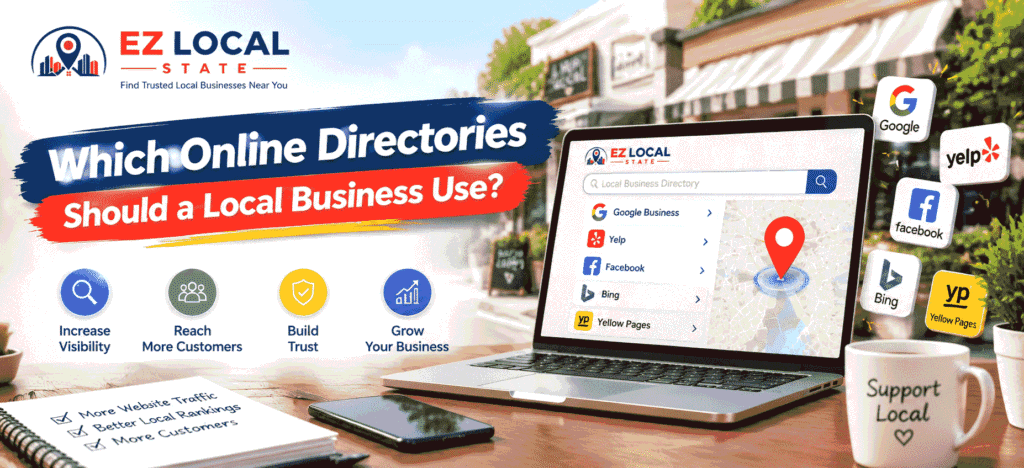
Not every business needs the same directory strategy. A restaurant, dentist, attorney, roofer, and software consultant may serve different audiences. Start with major platforms, then expand into general directories, local resources, and industry-specific websites that fit your market.
For U.S. businesses, the strongest approach is usually tiered. Establish your core profiles first, then add relevant sources that customers trust. This keeps directory management practical while avoiding the temptation to create dozens of neglected profiles.
Essential Business Listings for U.S. Businesses
Start with platforms that have broad customer reach or ecosystem value. Google Business Profile should usually receive careful attention because it controls the business’s presence across Google Search and Maps. Apple Business Connect also lets businesses manage how they appear across Apple services.
Depending on your audience, consider Bing Places, Yelp, Facebook, and Apple Business Connect alongside Google. Each platform serves a different ecosystem. Your goal should be accurate, complete profiles rather than blindly copying the same strategy onto every available website.
General Online Business Directories
General directories can expand your digital footprint and help customers discover your company through additional sources. Examples include Better Business Bureau, Yellow Pages, MapQuest, Foursquare, Nextdoor, Manta, Hotfrog, Trustpilot, and MerchantCircle.
Their value varies by industry, market, and audience. Before creating a profile, examine whether the directory appears legitimate, relevant, maintained, and useful. A directory shouldn’t make your strategy simply because it accepts submissions. Quality deserves the final vote.
Industry-Specific Directories
Niche directories can be powerful because they connect your business with a particular service category. An attorney may consider legal directories, while a contractor may benefit from reputable home-service platforms. Healthcare businesses face an entirely different directory landscape.
The strongest trade directories often provide context that general sites cannot. They can associate your company with a specific profession, service, or industry. That makes niche directories worth researching before spending time on broad, low-value platforms.
Local and Community Directories
Local organizations can add another layer of relevance. Consider chambers of commerce, regional business associations, local publications, community organizations, and respected industry groups.
These sources can support your local directories strategy because they connect your company with a particular community. A local chamber profile, for example, may be useful for reputation and discovery even when it doesn’t produce a large amount of direct traffic.
How Many Business Directories Does a Business Need?
There isn’t a universal magic number. A better strategy starts with essential platforms, expands into relevant general directories, and then adds industry or local sources. The right number depends on your business type, market, competitors, and ability to keep profiles accurate.
| Directory Type | Primary Purpose | Recommended Approach |
| Major platforms | Broad discovery | Prioritize first |
| General directories | Wider coverage | Select reputable sources |
| Industry directories | Relevance | Prioritize strong niche sources |
| Local directories | Community relevance | Choose credible local resources |
| Low-quality directories | Minimal value | Usually avoid |
How to Create and Claim a Local Business Listing
Creating a profile is only the beginning. First, establish one reliable source of truth for your business details. Then claim existing profiles before creating new ones. This prevents duplicate records and makes future local listing management much easier.
Google recommends keeping Business Profile information accurate and complete. Its guidance also explains that Google combines information supplied by businesses with public web content, third-party data, and user contributions.
Create a Master Business Information Record
Before submitting anything, create a master record containing your official business name, address, phone number, website, hours, categories, services, description, and important branding information.
This document becomes your reference point. If several people manage your profiles, it also prevents small inconsistencies from creeping into different accounts. Your business information should have one approved version before you begin large-scale citation work.
Claim Existing Business Profiles
Search for your business before creating a new profile. You may discover old listings, profiles created by customers, outdated pages, or records inherited from a previous owner.
Claim the correct profile whenever the platform allows it. If a duplicate exists, follow the platform’s correction or merge process instead of creating another record. This approach makes directory cleanup much simpler later.
Complete Every Important Profile Field
A half-finished profile wastes an opportunity. Add relevant categories, services, hours, photos, descriptions, website details, and other fields offered by the platform.
Google specifically recommends accurate business information and provides options for physical addresses and service areas. Your primary category, secondary categories, and service information should accurately describe the business rather than simply target popular keywords.
Verify Your Business Information
After creating or claiming a listing, compare every field against your master record. Check the name, address, phone, website, hours, category, and service area.
Verification also matters because platforms need to establish that the person managing a profile has authority to represent the business. Keep evidence and account access organized. That small habit can save significant time when ownership questions arise later.
Handle Existing, Duplicate, or Unclaimed Listings
Old listings can become surprisingly messy. A business may have moved, changed its phone number, rebranded, or acquired another company. Those changes can leave behind profiles containing outdated information.
Start with a citation audit before making widespread submissions. Record each profile, its URL, current information, ownership status, and required action. Then prioritize important corrections instead of trying to fix everything randomly.
How to Optimize Local Business Listings for Maximum SEO
Optimization means making every profile useful, accurate, and relevant. It doesn’t mean stuffing city names into every field. Search engines need understandable information, while customers need clear answers.
Start with your official business details. Then improve categories, services, descriptions, photos, hours, links, and reviews. This creates stronger directory profiles while keeping the experience natural for real people.
Optimize Your Business Name Without Keyword Stuffing
Use your legitimate business name. Don’t turn the profile name into a string of services and locations simply because you want additional keywords.
For example, if the real company name is “Summit Roofing,” don’t change it to “Summit Roofing Best Roof Repair Dallas Texas.” That approach can violate platform guidelines and create a poor customer experience. Accurate business name information always comes first.
Choose the Right Business Categories
Categories help platforms understand what your company does. Choose the most specific primary category that accurately represents the business. Add secondary categories only when they genuinely describe additional services.
Google specifically warns against using categories solely as keywords. Your business category should describe the company itself. A precise category can provide clearer relevance than a long collection of loosely related options.
Write a Useful Business Description
A good description answers three basic questions: What do you offer? Who do you serve? Why should someone consider you?
Use natural language and mention important services without repetition. If you serve several communities, describe your service area accurately. A helpful business description should sound like a person explaining the company, not an SEO system stuffed with phrases.
Optimize Services and Products
Service fields provide useful context. A home-service company might describe roof repair, roof replacement, inspections, storm damage repair, and maintenance if those services are genuinely available.
Keep terminology consistent with your website and other profiles. Where platforms support links, connect customers with relevant service pages. This creates a useful bridge between directory listings and deeper website information.
Add High-Quality Photos and Visual Assets
Photos can influence how customers perceive your company before they read a single sentence. Use clear images that show your actual business, team, products, projects, vehicles, or location.
Your business photos should be authentic and current. A recognizable business logo can reinforce branding, while service images can help customers understand what they can expect. Avoid generic stock imagery when real photographs are available.
Keep Business Hours Accurate
Incorrect hours create immediate frustration. Someone who drives to a closed store or calls during unavailable hours may not return.
Update regular hours, holiday hours, temporary closures, and seasonal schedules whenever they change. Treat business hours as operational information rather than decorative profile content. Accurate hours can improve customer trust and reduce unnecessary calls.
Build and Manage Customer Reviews
Reviews provide social proof and help prospective customers understand what working with your company feels like. Ask genuine customers for honest feedback without offering rewards or manipulating what they say.
Respond to reviews with professionalism. Thank customers for positive feedback and address legitimate concerns calmly. Strong customer reviews and thoughtful responses can strengthen your reputation while creating useful information for future buyers.
Optimize Links and Landing Pages
Don’t automatically send every directory visitor to your homepage. When a platform permits a relevant link, send users to the page that answers their immediate question.
For example, a plumbing directory profile could link to a plumbing services page. A restaurant profile could link to its menu. This approach can improve website visibility and create more meaningful referral traffic.
Local Citations, NAP Consistency, and Duplicate Listings
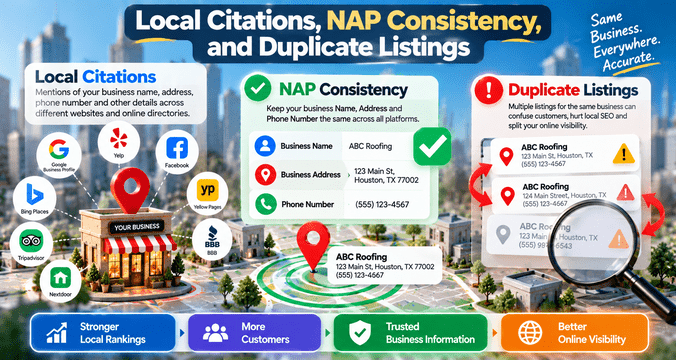
Local citations form part of the information ecosystem surrounding your company. Search engines can use information from websites, directories, users, and other sources. Google confirms that it compiles Business Profile information from multiple sources, including public web content and third-party data.
Because information can come from many places, errors can spread. An old phone number may remain on one profile for years. A previous address may appear elsewhere. Strong citation management helps you find these problems before they confuse customers or undermine your online presence.
What Is NAP Consistency?
NAP stands for name, address, and phone number. These details identify your business across many online sources.
Consistency doesn’t mean every platform must use identical punctuation. It means the underlying information should remain accurate and clearly refer to the same business. Strong NAP consistency reduces ambiguity and makes your digital identity easier to understand.
Why Inconsistent Business Information Creates Problems
Imagine finding a contractor with three different phone numbers across the web. Which number would you trust? Most customers won’t investigate. They’ll simply move to another company.
That example shows why citation accuracy matters. Inconsistent information can confuse customers, complicate updates, and weaken the credibility of your online presence. Accurate records also make future local SEO work easier to manage.
How to Find Incorrect Local Citations
Start with simple searches. Search your business name, phone number, previous address, and old business name when applicable. Compare what appears against your master record.
Look especially for profiles with outdated information. Record every discrepancy rather than trying to remember them. A structured citation audit gives you a clear correction queue and prevents important errors from disappearing into a pile of browser tabs.
How to Handle Duplicate Business Listings
Duplicate profiles can split attention and create conflicting information. The correct solution depends on the platform and situation.
First identify which profile represents the legitimate business record. Then use the platform’s official correction, merge, or support process where available. Don’t create another profile to compete with an existing one. Good directory cleanup begins with consolidation.
Create a Citation Audit and Cleanup Process
A spreadsheet can turn a chaotic task into a repeatable system. Record the directory name, profile URL, business details, ownership status, login information, date checked, and correction status.
The result becomes a living inventory of your business citations. Review high-value profiles more often, especially after a move, phone change, rebrand, ownership transition, or major service update.
How Local Listings Help Google, Maps, and AI Search
Search behavior keeps changing. Customers now discover businesses through traditional search, maps, review websites, social platforms, and AI-powered interfaces. That makes consistent digital information increasingly useful.
Google explains that business information can come from several sources and then appear across Search and Maps. Your local listings therefore shouldn’t operate in isolation. Your website and external profiles should communicate the same factual business identity.
How Search Engines Use Business Information
Search engines need context. They need to understand what a business does, where it operates, and which searches might match its services.
Your website, listings, reviews, links, and other online references can contribute to that understanding. Google’s local guidance emphasizes relevance, distance, and prominence when determining local results. This makes local ranking factors broader than directory quantity alone.
How Local Listings Support Google Maps Visibility
Google Business Profile is central to visibility on Google Maps. Businesses can provide hours, website details, location information, photos, and other customer-facing information through their profile.
However, no legitimate directory strategy guarantees a position in the Google Maps Pack. Google’s system considers several factors. Your job is to make the business easy to understand, accurately represented, and genuinely useful for the searches you want to serve.
How AI Search Uses Local Business Information
AI search systems can draw information from websites and external sources when generating answers. That creates a new reason to maintain consistent business facts across the web.
A strong AI search presence doesn’t come from stuffing prompts or publishing artificial text. Instead, build a reliable information ecosystem. Keep your website detailed, your profiles accurate, and your business identity consistent across trustworthy online directory sites.
Optimize Listings for AI Discovery
AI systems need factual information they can interpret. Complete profiles provide more context than bare listings with only a name and phone number.
Make your services clear. Keep your hours current. Describe your business accurately. Maintain relevant profiles. Connect listings to useful website pages. This creates a stronger AI visibility foundation without chasing every new search platform individually.
Why Your Website and Listings Should Work Together
Your listings provide concise business facts. Your website provides depth. These assets should reinforce one another rather than contradict each other.
For example, your profile might mention emergency HVAC repair while your website explains the service, process, pricing factors, and availability. This relationship creates a richer online presence and gives customers more information before they contact you.
How to Manage and Maintain Your Local Business Listings
Listing optimization isn’t a one-time upload. Businesses change constantly. Phones change, staff changes, services expand, hours shift, and companies move.
A simple maintenance rhythm keeps your profiles healthy. Strong local listing management means checking important information regularly, responding to customers, updating photos, and correcting errors before they become persistent problems.
Perform Regular Listing Audits
Set a recurring review schedule. Check your most important profiles first, then review secondary directories when time allows.
Look for outdated contact details, broken website links, incorrect categories, old hours, duplicate profiles, and missing services. A recurring directory audit is easier than rebuilding your digital presence after years of neglect.
Update Listings After Business Changes
Treat major business changes as triggers for a listing review. A new address, phone number, website, service, or brand name can affect numerous profiles.
Update your master record first. Then work through your directory inventory systematically. This creates a clean sequence: source information first, external profiles second. That process reduces listing management errors.
Keep Photos and Services Current
Customers notice stale profiles. If your company has changed dramatically but the directory still shows five-year-old photos, the profile may feel neglected.
Refresh important images when your business evolves. Update service descriptions as offerings change. Remove discontinued services where necessary. Fresh business profiles should reflect the company customers will actually encounter.
Monitor Reviews and Customer Questions
Reviews can become a valuable customer-service channel. Respond to genuine feedback and answer questions clearly when the platform allows it.
Don’t treat every negative review as a crisis. Instead, look for recurring issues. If several customers mention the same problem, that feedback may reveal something worth fixing operationally. Good reputation management connects marketing with real customer experience.
Build a Local Listing Management Workflow
A practical workflow can be simple. Maintain one master business record, one directory inventory, one update schedule, and one person responsible for final verification.
That system becomes especially important for businesses with several locations. Each location needs accurate details while the overall brand remains consistent. Strong directory management creates order where scattered profile updates would otherwise become difficult.
How to Measure Local Listing Performance and Improve Results
Ranking alone doesn’t tell the whole story. A listing can appear frequently yet generate little business. Another profile may produce fewer views but deliver highly qualified calls.
Measure actions that connect visibility with business outcomes. Track local search rankings, profile interactions, referral visits, calls, direction requests, inquiries, and conversions. Then use the data to decide which profiles deserve more attention.
Track Google Business Profile Performance
Google Business Profile can provide useful information about how customers interact with a profile. Depending on the profile and available reporting, businesses can evaluate actions such as calls, website visits, directions, and search-related activity.
The important point is consistency. Review the same metrics over time rather than reacting to one unusual month. Google rankings can fluctuate, while customer actions often provide a clearer picture of practical performance.
Track Website Traffic From Directories
Use analytics to understand which directories send visitors. Where supported, tracking parameters can help separate referral sources and identify useful platforms.
Compare traffic quality rather than raw volume. Ten visitors who request quotes may be more valuable than one hundred visitors who leave immediately. This approach turns referral traffic into a business measurement instead of a vanity metric.
Monitor Local Search Rankings
Track important services across the locations you actually serve. Local rankings can vary by searcher location, query wording, competition, and other factors.
Use a consistent tracking method so comparisons remain meaningful. Monitor local pack rankings alongside organic results. Don’t obsess over one position. Look for sustained improvement across relevant searches and locations.
Measure Leads and Revenue
The final question is simple: did the listing help create business?
Connect calls, forms, bookings, quote requests, or purchases to your marketing data whenever possible. A directory that produces real customers deserves attention even if it doesn’t have the highest traffic. Inbound traffic only matters when it supports meaningful outcomes.
Identify Which Listings Actually Perform
Create a simple performance table and review it quarterly.
Google Business Profile: Track profile actions such as calls, website visits, and direction requests. Maintain and improve the profile based on its performance.
Industry directory: Monitor referral traffic and qualified leads. If it consistently generates valuable visitors or leads, consider investing more effort into it.
Local chamber: Review referral visibility and its contribution to brand credibility. Keep the listing accurate and up to date.
General directory: Check engagement and lead generation. If it produces little activity or few leads, reassess whether it is worth maintaining.
Review platform: Monitor customer reviews, trust signals, and inquiries. Pay close attention to changes in reviews and customer engagement.
This approach prevents you from spending hours maintaining profiles that provide little value. Your online visibility strategy should evolve according to evidence, relevance, and customer behavior rather than assumptions.
Build a Continuous Improvement Cycle
The strongest process is straightforward: audit your profiles, correct errors, improve useful information, measure results, and repeat.
Think of it as maintaining a storefront. You wouldn’t paint the building once and never inspect it again. Your digital storefront deserves the same care. Over time, disciplined local listing management can create a cleaner, more trustworthy presence.
Frequently Asked Questions About Local Business Listings
Are there any free business directories available?
Yes. Many directories offer free basic listings, including Google Business Profile, Yelp, Bing Places, and Facebook.
What are the top 10 business directories?
Common choices include Google Business Profile, Yelp, Bing Places, Apple Business Connect, Facebook, BBB, Yellow Pages, MapQuest, Foursquare, and Nextdoor.
What are the best local business directories in the USA?
Google Business Profile, Yelp, Apple Business Connect, Bing Places, BBB, and relevant industry-specific directories are strong options for U.S. businesses.
How to find local businesses without a website?
Search Google Maps, Yelp, Facebook, Yellow Pages, or local directories using the business name, service, and location.
How can I look up someone’s business?
Search the business name, phone number, or owner name on Google, Google Maps, business directories, and relevant state or local business records.